The next morning we go down for breakfast in our hotel, the Eurostars Zona Rosa Suites. It is a rather desultory affair, and each morning we hope it will get better, but it never does. It is a buffet with a few plates of fresh fruit cut into slices the previous evening, slices of cheese cut just after the fruit, individual packets of cereal, packaged sliced bread, thin slices of tinned ham, and some warming pans containing refried beans, rice and hotcakes. The hot food was obviously cooked many hours earlier and placed in the warming pans where it sits until 11.30 when it is cleared away.
This morning there is a table of three Mexicans who look a little scary. One of them must be at least 400 lbs and seems unable to sit upright, but instead slouches down at 45 degrees from the floor. We guess that sitting upright is impossible because his stomach would crush his legs. He is wearing a well worn track suit which hasn’t seen soap and water for some time. He hasn’t shaved for several days, and the last time he washed is when he had to take his track suit off to put it in the laundry. His two companions, while equally grubby are far less imposing and far smaller. We are wondering how they could afford to be staying in the hotel, when we notice that the two companions do everything for the large man. He just has to say that he wants more food and they jump up and get it for him. This obviously keeps them fit, as his calls for more are frequent. There is obviously some sort of hierarchy going on here that we know nothing of, but might explain how they can afford to stay in this hotel.
Showing posts with label Mexico City. Show all posts
Showing posts with label Mexico City. Show all posts
Wednesday, September 16, 2009

Monday, September 14, 2009
The Colonia Condessa followed by a Wonderful Dinner
Colonia Condessa is a European style neighborhood, full of trendy sidewalk cafes and restaurants, hip bars and small fashionable boutiques. It is considered “the bohemian pulse of the city” whatever that means, and is fast overtaking Zona Rosa as the place to be seen. However on a Monday morning the streets are deserted. The neighborhood dates back to the early 20th century and the architecture of the houses is a fascinating mix of Moorish and Art Deco. Here, many of the houses are renovated and the expensive cars lining the streets show it is one of the well to do suburbs. We feel quite at home and spend a leisurely few hours exploring the shopping and residential streets of the neighborhood.

In the evening we go to a small French Restaurant, Bistrot Arlequin at Rio Nilo 42, a ten minute walk from our hotel. We have read about it on the Internet and know that it is off the beaten track with no sign – you just have to listen for French being spoken.

The restaurant is tiny and is obviously in a converted two car garage. One metal roll up door serves as the entrance while the other door has been replaced with a huge window. Inside it is an ergonomic miracle, with seating for 28, a full bar, and a tiny open kitchen all crammed into the space. The tables are very close together, but the atmosphere is fun and relaxed.


We have no problem recognizing that the chef, the owner and the waiter are all French. They take very frequent breaks together and stand just outside the roll up door together chatting and smoking, the fumes wafting into the restaurant.
The waiter is young, tall and scruffy. His clothes would look better with the help of an iron. His shirt is partially untucked, hanging outside his trousers. His hair is long and lank and pushed back behind his ears. All his features are oversized, his large oval eyes are set very far apart and his Gallic nose does its best to fill the space between them. His huge hands hang limply from his wrists. It seems that his height is recently acquired as he moves rather awkwardly and appears unprepared for how far down he has to reach to pick up things. He exudes an aura of excitement that so many young people have with a new job, which only partly makes up for his inefficiency. In another example of Gallic behaviour he is eating his own dinner while serving us ours. Fortunately he is helped by two women who are friendly and excellent.
The chef is a dashingly handsome slim man around 40 years old, with his long black hair pulled tightly to the back of his head and tied in a pony tail. He has a cleft chin that Michael Douglas would envy. He wears slim cut black and white chef trousers, a black shirt and a black apron. The only colour is a dazzling gold necklace. Mon dieu!
The food is excellent and quite reasonable, and the wine list small but interesting. The restaurant is full and we can’t believe that the chef can turn out all the food in a timely manner, but he does.

In the evening we go to a small French Restaurant, Bistrot Arlequin at Rio Nilo 42, a ten minute walk from our hotel. We have read about it on the Internet and know that it is off the beaten track with no sign – you just have to listen for French being spoken.

The restaurant is tiny and is obviously in a converted two car garage. One metal roll up door serves as the entrance while the other door has been replaced with a huge window. Inside it is an ergonomic miracle, with seating for 28, a full bar, and a tiny open kitchen all crammed into the space. The tables are very close together, but the atmosphere is fun and relaxed.


We have no problem recognizing that the chef, the owner and the waiter are all French. They take very frequent breaks together and stand just outside the roll up door together chatting and smoking, the fumes wafting into the restaurant.
The waiter is young, tall and scruffy. His clothes would look better with the help of an iron. His shirt is partially untucked, hanging outside his trousers. His hair is long and lank and pushed back behind his ears. All his features are oversized, his large oval eyes are set very far apart and his Gallic nose does its best to fill the space between them. His huge hands hang limply from his wrists. It seems that his height is recently acquired as he moves rather awkwardly and appears unprepared for how far down he has to reach to pick up things. He exudes an aura of excitement that so many young people have with a new job, which only partly makes up for his inefficiency. In another example of Gallic behaviour he is eating his own dinner while serving us ours. Fortunately he is helped by two women who are friendly and excellent.
The chef is a dashingly handsome slim man around 40 years old, with his long black hair pulled tightly to the back of his head and tied in a pony tail. He has a cleft chin that Michael Douglas would envy. He wears slim cut black and white chef trousers, a black shirt and a black apron. The only colour is a dazzling gold necklace. Mon dieu!
The food is excellent and quite reasonable, and the wine list small but interesting. The restaurant is full and we can’t believe that the chef can turn out all the food in a timely manner, but he does.
Friday, September 11, 2009
The Metro
The next day, Monday, is a National Holiday and again we suspect everything will be closed. We ask our concierge at the front desk and she informs us that all the Museums are closed on Mondays anyway, but the stores will be open despite the holiday. She is wrong. The large stores are open but the smaller stores are not.
We decide to explore the Colonia Condessa, and take the Metro. It is our first experience of the Mexico City Metro system. It is the second largest subway system in the Americas, after New York, and is one of the world’s great architectural marvels. Because of the underground lake the entire 125 mile system had to be built so that it actually floats and can move up and down depending on the level of the lake. The trains run on pneumatic tires rather than steel tracks and move 5 million people a day smoothly and comfortably. It is efficient, fast and clean, and you might think all this would come at a price. But even more remarkable than its engineering is the fact that a ride of any distance is 2 pesos, about 15 cents. What more could anyone ask.
It’s three drawbacks are that at rush hour it is unbelievably crowded, there is a serious problem with pickpockets, and it is not safe for tourists at night.
The stations are often hard to find as the signage is poor, but once inside there are plenty of signs leading you to the correct platform. We wait until after 10am, hoping to avoid the crowds. The trains come every couple of minutes, but they are still amazingly busy and it is standing room only.
The system was started in the 60’s and is definitely shabby, but we are impressed by its cleanliness. There is no litter anywhere. The other noticeable difference from other major subways is all the backlit frames that line the walls are empty – there are no advertisers.
Very few of the riders are what might be called middle class: very few business suits, or well dressed women. This is transport for the working class masses.
There is one innovation that should be copied everywhere. During rush hour the front two cars are reserved for women and children only. We are also impressed to see the young give up their seats to the elderly. But unfortunately no one stands up for me.
We decide to explore the Colonia Condessa, and take the Metro. It is our first experience of the Mexico City Metro system. It is the second largest subway system in the Americas, after New York, and is one of the world’s great architectural marvels. Because of the underground lake the entire 125 mile system had to be built so that it actually floats and can move up and down depending on the level of the lake. The trains run on pneumatic tires rather than steel tracks and move 5 million people a day smoothly and comfortably. It is efficient, fast and clean, and you might think all this would come at a price. But even more remarkable than its engineering is the fact that a ride of any distance is 2 pesos, about 15 cents. What more could anyone ask.
It’s three drawbacks are that at rush hour it is unbelievably crowded, there is a serious problem with pickpockets, and it is not safe for tourists at night.
The stations are often hard to find as the signage is poor, but once inside there are plenty of signs leading you to the correct platform. We wait until after 10am, hoping to avoid the crowds. The trains come every couple of minutes, but they are still amazingly busy and it is standing room only.
The system was started in the 60’s and is definitely shabby, but we are impressed by its cleanliness. There is no litter anywhere. The other noticeable difference from other major subways is all the backlit frames that line the walls are empty – there are no advertisers.
Very few of the riders are what might be called middle class: very few business suits, or well dressed women. This is transport for the working class masses.
There is one innovation that should be copied everywhere. During rush hour the front two cars are reserved for women and children only. We are also impressed to see the young give up their seats to the elderly. But unfortunately no one stands up for me.
Wednesday, September 9, 2009
The Blue Tile House and the Palace of Fine Arts
As we wander through the streets leading from the Zocolo, two buildings attract our attention. The first is known as the Blue Tile House. It was built in the 16th century and is covered, not surprisingly, in hand made blue tiles from that period. Inside, is a Sanborns department store with a wonderful restaurant with walls covered in murals from the 1930’s.

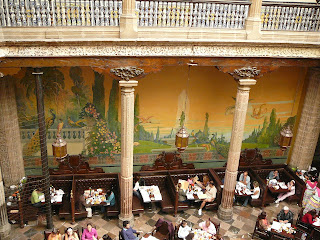
The second building is the Palace of Fine Arts, which is an absolutely fabulous building from the Art Deco/Beaux Arts period. Inside there are three levels all covered in Murals by famous artists of the period including Diego Rivera.


Any wall that hasn’t got a mural is clad in wonderful pink marble and edged in black. Staircases are either in black or white marble. Every detail is striking in its art deco design, even down to the small ticket office windows.

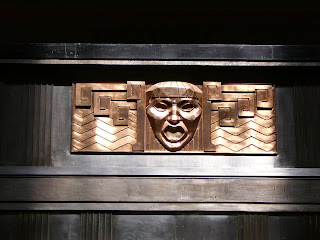
As we both collect Art Deco we are in heaven and spend two hours wandering around the building examining every amazing detail. The building houses a theatre with a famous Tiffany Curtain which we long to see, but sadly the theatre is closed for the weekend.
After lunch, we get back on the Turibus and continue round the City. We are impressed with the number and size of the parks and green areas. Many of the main streets are huge boulevards, split by a park like divide full of trees and benches. There is art everywhere: posters of famous artworks line one street, photographs of famous building line another and everywhere there are seats and benches often designed by famous artists in modern designs. If all this street art appeared in any European or North American city, it would be vandalized and covered in graffiti, but here everything is left untouched.
The city is full of statues . We spend most of the day listening on our headphones to endless descriptions of this statue of a famous Mexican President and that Statue of a famous revolutionary. But the only time we get excited is when we drive past a statue of Delores Del Rio , but no mention is made of it through our headphones.
In the evening we dine in an Argentinean restaurant – the city is full of them. Sadly it has a large screen TV inside, tuned to the Superbowl which is being played today. The restaurant is full of Mexicans all yelling and screaming for their favorite team.


The second building is the Palace of Fine Arts, which is an absolutely fabulous building from the Art Deco/Beaux Arts period. Inside there are three levels all covered in Murals by famous artists of the period including Diego Rivera.


Any wall that hasn’t got a mural is clad in wonderful pink marble and edged in black. Staircases are either in black or white marble. Every detail is striking in its art deco design, even down to the small ticket office windows.


As we both collect Art Deco we are in heaven and spend two hours wandering around the building examining every amazing detail. The building houses a theatre with a famous Tiffany Curtain which we long to see, but sadly the theatre is closed for the weekend.
After lunch, we get back on the Turibus and continue round the City. We are impressed with the number and size of the parks and green areas. Many of the main streets are huge boulevards, split by a park like divide full of trees and benches. There is art everywhere: posters of famous artworks line one street, photographs of famous building line another and everywhere there are seats and benches often designed by famous artists in modern designs. If all this street art appeared in any European or North American city, it would be vandalized and covered in graffiti, but here everything is left untouched.
The city is full of statues . We spend most of the day listening on our headphones to endless descriptions of this statue of a famous Mexican President and that Statue of a famous revolutionary. But the only time we get excited is when we drive past a statue of Delores Del Rio , but no mention is made of it through our headphones.
In the evening we dine in an Argentinean restaurant – the city is full of them. Sadly it has a large screen TV inside, tuned to the Superbowl which is being played today. The restaurant is full of Mexicans all yelling and screaming for their favorite team.
Monday, September 7, 2009
Zocolo and the Palace of Fine Arts
We get off the Turibus at the area called the Zocolo . This is the historic, political and cultural heart of Mexico City. It is built on top of the remains of the centre of the Aztec Empire, which in turn was built on top of a series of lakes and canals. The Spanish drained the waterways but the land was still little more than a swamp. Since then, the soft ground and the pumping of underground water for the city’s needs has meant that much of Mexico City’s historic heart is sinking. The Catedral Metropolitana alone has sunk 7m (23ft) since it was built. It is one of the most impressive baroque cathedrals in the world. But much of it appears to be leaning at a rather alarming angle. Indeed it is hard to see some of the gorgeous interior because of all the scaffolding needed to keep the massive structure from collapsing.
The streets of the Zocolo are narrow and lined with architectural examples from every period of Mexican history. Again the streets are all closed to traffic and the area is full of pedestrians. There are sidewalk cafes and restaurants, trendy stores, street musicians and a lot of police. The police presence is strong throughout the city. Many of them ride Segways, which seems extravagant for a poor country. The number of police is actually a little alarming, as is the fact that nearly all stores and restaurants of any size employ security guards to stand at their door. Even Burger King employs security guards, which seems a little superfluous. What self respecting crook would want to steal a Burger King sandwich. We have been warned to be careful, especially at night, but we feel perfectly safe in the tourist areas.
The streets of the Zocolo are narrow and lined with architectural examples from every period of Mexican history. Again the streets are all closed to traffic and the area is full of pedestrians. There are sidewalk cafes and restaurants, trendy stores, street musicians and a lot of police. The police presence is strong throughout the city. Many of them ride Segways, which seems extravagant for a poor country. The number of police is actually a little alarming, as is the fact that nearly all stores and restaurants of any size employ security guards to stand at their door. Even Burger King employs security guards, which seems a little superfluous. What self respecting crook would want to steal a Burger King sandwich. We have been warned to be careful, especially at night, but we feel perfectly safe in the tourist areas.
Friday, September 4, 2009
Mexico City by Turibus
It is a beautiful sunny day with a strong breeze that keeps Mexico City’s well known smog from settling in and we have a wonderful view of the different neighborhoods from the upper deck of the Turibus. However at times, there is an element of danger as we pass under trees whose limbs smack us across our forehead if we don’t duck in time.
The centre of the city was designed and built in the 19th century by the Emperor Maximilian, a Frenchman of enormous wealth and very little intellect, who somehow found himself in Mexico. He was homesick for France and decided to build a city that reminded him of his beloved Paris. In this he was successful and today the boulevards, parks and buildings all remind us of that fabulous city.

Alongside these European streets are some wonderfully evocative Art Nouveau and Art Deco buildings that rose up during the City’s renaissance during the early 20th century. There are walls of Tiffany glass and stunning Diego Rivera murals, and entire suburbs of wonderful art deco architecture. Other wealthy suburbs are full of impressive 18th and 19th century houses and mansions.
But Mexico City also has its less glamorous side and we pass through areas that are in stark relief to the magnificence of the main streets. Many of the areas, just a couple of streets away from the European boulevards, are extremely poor , with shabby run down buildings of indeterminate age, shoddily built with cheap materials that blight the streets with their uncared for exteriors. In fact a large percentage of these buildings appear to be derelict. It is interesting to note that the endless small apartment buildings of the mid 20th century are not handling the ravages of time nearly as well as their older counterparts.
The centre of the city was designed and built in the 19th century by the Emperor Maximilian, a Frenchman of enormous wealth and very little intellect, who somehow found himself in Mexico. He was homesick for France and decided to build a city that reminded him of his beloved Paris. In this he was successful and today the boulevards, parks and buildings all remind us of that fabulous city.

Alongside these European streets are some wonderfully evocative Art Nouveau and Art Deco buildings that rose up during the City’s renaissance during the early 20th century. There are walls of Tiffany glass and stunning Diego Rivera murals, and entire suburbs of wonderful art deco architecture. Other wealthy suburbs are full of impressive 18th and 19th century houses and mansions.
But Mexico City also has its less glamorous side and we pass through areas that are in stark relief to the magnificence of the main streets. Many of the areas, just a couple of streets away from the European boulevards, are extremely poor , with shabby run down buildings of indeterminate age, shoddily built with cheap materials that blight the streets with their uncared for exteriors. In fact a large percentage of these buildings appear to be derelict. It is interesting to note that the endless small apartment buildings of the mid 20th century are not handling the ravages of time nearly as well as their older counterparts.
Wednesday, September 2, 2009
Sunday in Mexico City
Our first day is a Sunday and nothing much is open, so we decide to take the Bus Tour of the city on a double decker bus known as the Turibus. It has no roof on the top floor to allow for excellent sightseeing, costs a little over $10 and lasts three hours, plus you can get off and on as many times as you want. There is a bus stop next to the Angel de la Independencia, Mexico City’s best known monument, on Paseo de la Reforma, it’s most important thoroughfare. The monument is just three blocks from the Hotel so we walk over there at about 10 in the morning.

We are amazed to find the main avenue of the Paseo de la Reforma completely closed to traffic and handed over to cyclists and pedestrians. It’s a fabulous idea and one much appreciated by the locals who pack the street on a sunny Sunday morning. At the foot of the Angel de la Independencia there is a free aerobics class being given by an energetic young man in an extremely tight fitting outfit. He is on a stage with music blaring and a crowd of well over 100 fans following his every move. It reminds me of the compulsory exercise and Tai Chi classes that we saw every morning in China. But here the only compulsion is to be a fan of the instructor. And many are, as they seem to know every routine without waiting for his instructions. The routines are amazingly difficult and involve a great deal of gyrating of the hips which the instructor does with great style, but only a few in the crowd manage with aplomb. The excitement, and fun quotient increases greatly when Hula Hoops are handed out to the entire crowd, and the instructor begins a whole new routine using these large plastic hoops. It looks like something from a camp Broadway show. Fortunately our bus arrives just in time to stop us getting carried away and joining in.

We are amazed to find the main avenue of the Paseo de la Reforma completely closed to traffic and handed over to cyclists and pedestrians. It’s a fabulous idea and one much appreciated by the locals who pack the street on a sunny Sunday morning. At the foot of the Angel de la Independencia there is a free aerobics class being given by an energetic young man in an extremely tight fitting outfit. He is on a stage with music blaring and a crowd of well over 100 fans following his every move. It reminds me of the compulsory exercise and Tai Chi classes that we saw every morning in China. But here the only compulsion is to be a fan of the instructor. And many are, as they seem to know every routine without waiting for his instructions. The routines are amazingly difficult and involve a great deal of gyrating of the hips which the instructor does with great style, but only a few in the crowd manage with aplomb. The excitement, and fun quotient increases greatly when Hula Hoops are handed out to the entire crowd, and the instructor begins a whole new routine using these large plastic hoops. It looks like something from a camp Broadway show. Fortunately our bus arrives just in time to stop us getting carried away and joining in.
Monday, August 31, 2009
A Trip to Mexico City
We spend several months a year in Puerto Vallarta and love it. In fact we love it so much we have never left it to explore the rest of the country. But today we are finally doing something about that. We are flying to Mexico City for three days to start off a 15 day trip to the east of the country.
We are doing all our flights on Aviacsa Airlines, one of Mexico’s new low cost airlines, and are impressed by the clean new planes, the ample leg room and the efficient service.
We have heard horror stories about Mexico City’s huge airport, and expect the worst. But we are pleasantly surprised. Admittedly we arrive at the domestic terminal, and not the International one, but we are off the plane and into a taxi, with our luggage in hand all in the space of 15 minutes.
The taxis too are a vast improvement on the ones we are used to in Puerto Vallarta. These are new, clean and metered. The driver is wearing an elegantly pressed white shirt and tie with a rather natty waistcoat.
We are staying in the Zona Rosa, which everyone tells us is a lively and safe neighborhood close to the City center. It is one of the city's most touristy areas, filled with hotels, dance clubs, restaurants, bars and live music. Zona Rosa means “the Pink Area” which is appropriate as it is home to a large gay population. Our hotel is on Londres Street which no one told us was THE gay street. It is packed with mainly young gay men. Mexico City has passed a law allowing gay unions, an extremely advanced action for a Catholic country. The young gays in the area are definitely out and proud, many holding hands as they walk along the street.
We are amused to see that the latest street fashion for these young men is extremely tight jeans often paired with white Go Go boots. Their main accessory is hair gel, which they appear to ladle on with a trowel.
We are staying at the EuroStars Zona Rosa Suites Hotel, which was obviously a very hip hotel in its day, but its day passed several years ago and now it is comfortable but fading.
We are doing all our flights on Aviacsa Airlines, one of Mexico’s new low cost airlines, and are impressed by the clean new planes, the ample leg room and the efficient service.
We have heard horror stories about Mexico City’s huge airport, and expect the worst. But we are pleasantly surprised. Admittedly we arrive at the domestic terminal, and not the International one, but we are off the plane and into a taxi, with our luggage in hand all in the space of 15 minutes.
The taxis too are a vast improvement on the ones we are used to in Puerto Vallarta. These are new, clean and metered. The driver is wearing an elegantly pressed white shirt and tie with a rather natty waistcoat.
We are staying in the Zona Rosa, which everyone tells us is a lively and safe neighborhood close to the City center. It is one of the city's most touristy areas, filled with hotels, dance clubs, restaurants, bars and live music. Zona Rosa means “the Pink Area” which is appropriate as it is home to a large gay population. Our hotel is on Londres Street which no one told us was THE gay street. It is packed with mainly young gay men. Mexico City has passed a law allowing gay unions, an extremely advanced action for a Catholic country. The young gays in the area are definitely out and proud, many holding hands as they walk along the street.
We are amused to see that the latest street fashion for these young men is extremely tight jeans often paired with white Go Go boots. Their main accessory is hair gel, which they appear to ladle on with a trowel.
We are staying at the EuroStars Zona Rosa Suites Hotel, which was obviously a very hip hotel in its day, but its day passed several years ago and now it is comfortable but fading.
Subscribe to:
Posts (Atom)