The next day, Monday, is a National Holiday and again we suspect everything will be closed. We ask our concierge at the front desk and she informs us that all the Museums are closed on Mondays anyway, but the stores will be open despite the holiday. She is wrong. The large stores are open but the smaller stores are not.
We decide to explore the Colonia Condessa, and take the Metro. It is our first experience of the Mexico City Metro system. It is the second largest subway system in the Americas, after New York, and is one of the world’s great architectural marvels. Because of the underground lake the entire 125 mile system had to be built so that it actually floats and can move up and down depending on the level of the lake. The trains run on pneumatic tires rather than steel tracks and move 5 million people a day smoothly and comfortably. It is efficient, fast and clean, and you might think all this would come at a price. But even more remarkable than its engineering is the fact that a ride of any distance is 2 pesos, about 15 cents. What more could anyone ask.
It’s three drawbacks are that at rush hour it is unbelievably crowded, there is a serious problem with pickpockets, and it is not safe for tourists at night.
The stations are often hard to find as the signage is poor, but once inside there are plenty of signs leading you to the correct platform. We wait until after 10am, hoping to avoid the crowds. The trains come every couple of minutes, but they are still amazingly busy and it is standing room only.
The system was started in the 60’s and is definitely shabby, but we are impressed by its cleanliness. There is no litter anywhere. The other noticeable difference from other major subways is all the backlit frames that line the walls are empty – there are no advertisers.
Very few of the riders are what might be called middle class: very few business suits, or well dressed women. This is transport for the working class masses.
There is one innovation that should be copied everywhere. During rush hour the front two cars are reserved for women and children only. We are also impressed to see the young give up their seats to the elderly. But unfortunately no one stands up for me.
Showing posts with label local transportation. Show all posts
Showing posts with label local transportation. Show all posts
Friday, September 11, 2009

Wednesday, September 9, 2009
The Blue Tile House and the Palace of Fine Arts
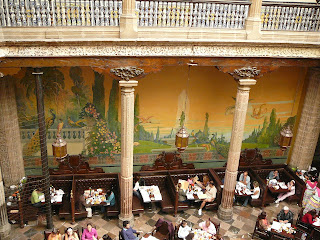
As we wander through the streets leading from the Zocolo, two buildings attract our attention. The first is known as the Blue Tile House. It was built in the 16th century and is covered, not surprisingly, in hand made blue tiles from that period. Inside, is a Sanborns department store with a wonderful restaurant with walls covered in murals from the 1930’s.

The second building is the Palace of Fine Arts, which is an absolutely fabulous building from the Art Deco/Beaux Arts period. Inside there are three levels all covered in Murals by famous artists of the period including Diego Rivera.


Any wall that hasn’t got a mural is clad in wonderful pink marble and edged in black. Staircases are either in black or white marble. Every detail is striking in its art deco design, even down to the small ticket office windows.

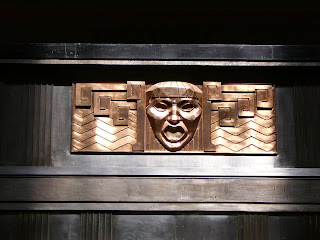
As we both collect Art Deco we are in heaven and spend two hours wandering around the building examining every amazing detail. The building houses a theatre with a famous Tiffany Curtain which we long to see, but sadly the theatre is closed for the weekend.
After lunch, we get back on the Turibus and continue round the City. We are impressed with the number and size of the parks and green areas. Many of the main streets are huge boulevards, split by a park like divide full of trees and benches. There is art everywhere: posters of famous artworks line one street, photographs of famous building line another and everywhere there are seats and benches often designed by famous artists in modern designs. If all this street art appeared in any European or North American city, it would be vandalized and covered in graffiti, but here everything is left untouched.
The city is full of statues . We spend most of the day listening on our headphones to endless descriptions of this statue of a famous Mexican President and that Statue of a famous revolutionary. But the only time we get excited is when we drive past a statue of Delores Del Rio , but no mention is made of it through our headphones.
In the evening we dine in an Argentinean restaurant – the city is full of them. Sadly it has a large screen TV inside, tuned to the Superbowl which is being played today. The restaurant is full of Mexicans all yelling and screaming for their favorite team.


The second building is the Palace of Fine Arts, which is an absolutely fabulous building from the Art Deco/Beaux Arts period. Inside there are three levels all covered in Murals by famous artists of the period including Diego Rivera.


Any wall that hasn’t got a mural is clad in wonderful pink marble and edged in black. Staircases are either in black or white marble. Every detail is striking in its art deco design, even down to the small ticket office windows.


As we both collect Art Deco we are in heaven and spend two hours wandering around the building examining every amazing detail. The building houses a theatre with a famous Tiffany Curtain which we long to see, but sadly the theatre is closed for the weekend.
After lunch, we get back on the Turibus and continue round the City. We are impressed with the number and size of the parks and green areas. Many of the main streets are huge boulevards, split by a park like divide full of trees and benches. There is art everywhere: posters of famous artworks line one street, photographs of famous building line another and everywhere there are seats and benches often designed by famous artists in modern designs. If all this street art appeared in any European or North American city, it would be vandalized and covered in graffiti, but here everything is left untouched.
The city is full of statues . We spend most of the day listening on our headphones to endless descriptions of this statue of a famous Mexican President and that Statue of a famous revolutionary. But the only time we get excited is when we drive past a statue of Delores Del Rio , but no mention is made of it through our headphones.
In the evening we dine in an Argentinean restaurant – the city is full of them. Sadly it has a large screen TV inside, tuned to the Superbowl which is being played today. The restaurant is full of Mexicans all yelling and screaming for their favorite team.
Monday, September 7, 2009
Zocolo and the Palace of Fine Arts
We get off the Turibus at the area called the Zocolo . This is the historic, political and cultural heart of Mexico City. It is built on top of the remains of the centre of the Aztec Empire, which in turn was built on top of a series of lakes and canals. The Spanish drained the waterways but the land was still little more than a swamp. Since then, the soft ground and the pumping of underground water for the city’s needs has meant that much of Mexico City’s historic heart is sinking. The Catedral Metropolitana alone has sunk 7m (23ft) since it was built. It is one of the most impressive baroque cathedrals in the world. But much of it appears to be leaning at a rather alarming angle. Indeed it is hard to see some of the gorgeous interior because of all the scaffolding needed to keep the massive structure from collapsing.
The streets of the Zocolo are narrow and lined with architectural examples from every period of Mexican history. Again the streets are all closed to traffic and the area is full of pedestrians. There are sidewalk cafes and restaurants, trendy stores, street musicians and a lot of police. The police presence is strong throughout the city. Many of them ride Segways, which seems extravagant for a poor country. The number of police is actually a little alarming, as is the fact that nearly all stores and restaurants of any size employ security guards to stand at their door. Even Burger King employs security guards, which seems a little superfluous. What self respecting crook would want to steal a Burger King sandwich. We have been warned to be careful, especially at night, but we feel perfectly safe in the tourist areas.
The streets of the Zocolo are narrow and lined with architectural examples from every period of Mexican history. Again the streets are all closed to traffic and the area is full of pedestrians. There are sidewalk cafes and restaurants, trendy stores, street musicians and a lot of police. The police presence is strong throughout the city. Many of them ride Segways, which seems extravagant for a poor country. The number of police is actually a little alarming, as is the fact that nearly all stores and restaurants of any size employ security guards to stand at their door. Even Burger King employs security guards, which seems a little superfluous. What self respecting crook would want to steal a Burger King sandwich. We have been warned to be careful, especially at night, but we feel perfectly safe in the tourist areas.
Monday, August 31, 2009
A Trip to Mexico City
We spend several months a year in Puerto Vallarta and love it. In fact we love it so much we have never left it to explore the rest of the country. But today we are finally doing something about that. We are flying to Mexico City for three days to start off a 15 day trip to the east of the country.
We are doing all our flights on Aviacsa Airlines, one of Mexico’s new low cost airlines, and are impressed by the clean new planes, the ample leg room and the efficient service.
We have heard horror stories about Mexico City’s huge airport, and expect the worst. But we are pleasantly surprised. Admittedly we arrive at the domestic terminal, and not the International one, but we are off the plane and into a taxi, with our luggage in hand all in the space of 15 minutes.
The taxis too are a vast improvement on the ones we are used to in Puerto Vallarta. These are new, clean and metered. The driver is wearing an elegantly pressed white shirt and tie with a rather natty waistcoat.
We are staying in the Zona Rosa, which everyone tells us is a lively and safe neighborhood close to the City center. It is one of the city's most touristy areas, filled with hotels, dance clubs, restaurants, bars and live music. Zona Rosa means “the Pink Area” which is appropriate as it is home to a large gay population. Our hotel is on Londres Street which no one told us was THE gay street. It is packed with mainly young gay men. Mexico City has passed a law allowing gay unions, an extremely advanced action for a Catholic country. The young gays in the area are definitely out and proud, many holding hands as they walk along the street.
We are amused to see that the latest street fashion for these young men is extremely tight jeans often paired with white Go Go boots. Their main accessory is hair gel, which they appear to ladle on with a trowel.
We are staying at the EuroStars Zona Rosa Suites Hotel, which was obviously a very hip hotel in its day, but its day passed several years ago and now it is comfortable but fading.
We are doing all our flights on Aviacsa Airlines, one of Mexico’s new low cost airlines, and are impressed by the clean new planes, the ample leg room and the efficient service.
We have heard horror stories about Mexico City’s huge airport, and expect the worst. But we are pleasantly surprised. Admittedly we arrive at the domestic terminal, and not the International one, but we are off the plane and into a taxi, with our luggage in hand all in the space of 15 minutes.
The taxis too are a vast improvement on the ones we are used to in Puerto Vallarta. These are new, clean and metered. The driver is wearing an elegantly pressed white shirt and tie with a rather natty waistcoat.
We are staying in the Zona Rosa, which everyone tells us is a lively and safe neighborhood close to the City center. It is one of the city's most touristy areas, filled with hotels, dance clubs, restaurants, bars and live music. Zona Rosa means “the Pink Area” which is appropriate as it is home to a large gay population. Our hotel is on Londres Street which no one told us was THE gay street. It is packed with mainly young gay men. Mexico City has passed a law allowing gay unions, an extremely advanced action for a Catholic country. The young gays in the area are definitely out and proud, many holding hands as they walk along the street.
We are amused to see that the latest street fashion for these young men is extremely tight jeans often paired with white Go Go boots. Their main accessory is hair gel, which they appear to ladle on with a trowel.
We are staying at the EuroStars Zona Rosa Suites Hotel, which was obviously a very hip hotel in its day, but its day passed several years ago and now it is comfortable but fading.
Monday, August 10, 2009
Pyin Oo Lwin
In the afternoon we fly back to Mandalay , and from there drive up to Pyin Oo Lwin . It is a slow drive up a steep and winding mountain road. There are police everywhere, and we are told that they are there to clear the road of all traffic as a convoy of VIP cars goes through. Our driver manages to sneak on the back of the convoy and we too get whisked up to Pyin Oo Lwin without having to deal with any other traffic. How we don’t get stopped by the police is a miracle, as the VIPS are all in huge modern four wheel drives, while we are in the usual twenty year old Toyota. It is nighttime, and driving is extremely dangerous as there are no street lights and the roads are full of bicyclists without lights or any reflective garments.
Pyin Oo Lwin is a hill station where the British retreated when they found the summer temperatures and humidity of Mandalay too much to take. Everywhere you can see the influence of the British, from the colonial style homes and their gardens, to the hotel where we stay. The hotel is an English Edwardian building complete with the drafts, rattling windows and linoleum floors, but without the hissing radiators. There is no form of heat, the place is freezing, and the bedrooms feel like dorms in an old English boarding school.
We are here to see the town, and the huge flower festival it holds every year. The festival is held in a large park with lovely walks through the gardens and round a lake. There is even a small zoo. The morning wandering around the park is lovely, the flower gardens are worth seeing, but the town is not.

Pyin Oo Lwin is a hill station where the British retreated when they found the summer temperatures and humidity of Mandalay too much to take. Everywhere you can see the influence of the British, from the colonial style homes and their gardens, to the hotel where we stay. The hotel is an English Edwardian building complete with the drafts, rattling windows and linoleum floors, but without the hissing radiators. There is no form of heat, the place is freezing, and the bedrooms feel like dorms in an old English boarding school.
We are here to see the town, and the huge flower festival it holds every year. The festival is held in a large park with lovely walks through the gardens and round a lake. There is even a small zoo. The morning wandering around the park is lovely, the flower gardens are worth seeing, but the town is not.

Monday, July 13, 2009
Crossing the Irrawaddy to Mingun
In the morning we take a boat across the Irrawaddy to Mingun. This might be the scariest boat we have been on in all our travels. It is large enough to hold thirty or 40 passengers, but it is just for us. There are dozens, if not hundreds of them, all identical, and all in various states of disrepair, tied up to the river bank. They are 6 deep against the bank, so you have to cross from one to another until you come to the outside one. They have an open upper deck and enclosed lower deck, but the lower deck is only 5ft tall, and it is through these that we have to travel to get to our personal boat. All the boats are moving in the current and it is quite treacherous going from one to the other. Finally we reach ours. I was assuming that we would have one of the ones that were in a better state of repair, but this was not to be. It was a complete wreck, and how we ever got across the river without it sinking is beyond me. As with so much else in the country, all the boats were built in the 1940’s when the British were here. Ours appears to have been untouched since then, which might be interesting in any other vehicle, but in a boat it is truly scary. The entire vessel seemed to sag in the middle, until the water almost came in over the sides. We are shown to the upper deck, which in fact is just the roof of the lower deck. It curves down to the edges, so that you feel you will slide off it. All there is to prevent us from doing so, is an extremely thin and rickety wooden railing held in place by a few spindly uprights attached to the floor by a couple of screws. The wooden floor is rotten in places and you can see straight through to the deck below. There are three extremely old and uncomfortable rattan chairs for us to sit on. Most of the rattan is broken and sticks into my body, tearing little holes in my shirt. There is also an extremely decrepit dining table. One of the crew (there are only 2) comes and lays a filthy old table cloth on it with a great flourish. The only thing dirtier than the table cloth is the young man putting it there. For one dreadful moment, we think food is going to be served, but in fact he is setting up a stall on which he lays a motley assortment of merchandise. There is nothing we would be remotely interested in buying, but considering we are half way across the huge Irrawaddy river, and completely at his mercy, we decide we better at least take a look.
We are told that there is a toilet downstairs but we are too afraid to venture down. However necessity, caused by a chilly wind, prevails. Added to the back of the boat is a small platform enclosed by a 4ft wall made of rush matting. You open a small door and step off the deck onto this small platform which appears to have no visible means of support. Standing on the platform was the toilet. It was not attached to the floor, or to any plumbing. It merely stood over a hole in the floor. The low height of the surrounding wall meant that all the passing ships were left in no doubt as to what you were doing there. Where is the Raffles Hotel when we need it.
We are suffering the indignities of this particularly unseaworthy vessel in order to see yet another largest bell in the world. This one is in a town called Mingun. We have already seen two other largest bells in the world in our travels, the most recent of which we saw in Russia . However our guide proudly tells us that the Russian one has a crack in it and so it doesn’t count. Myanmar ’s bell is perfect. However it is hung just a few inches off the ground in a crumbling building, completely uncared for and covered in cobwebs and large spiders. Adjacent to it is another crumbling building. This one is a home for aged monks. Our guide wants to show us round, but we are not interested, just grateful that this will not be our retirement home. For this we have just risked our lives crossing the Irrawaddy, and now we have to go back.
We are told that there is a toilet downstairs but we are too afraid to venture down. However necessity, caused by a chilly wind, prevails. Added to the back of the boat is a small platform enclosed by a 4ft wall made of rush matting. You open a small door and step off the deck onto this small platform which appears to have no visible means of support. Standing on the platform was the toilet. It was not attached to the floor, or to any plumbing. It merely stood over a hole in the floor. The low height of the surrounding wall meant that all the passing ships were left in no doubt as to what you were doing there. Where is the Raffles Hotel when we need it.
We are suffering the indignities of this particularly unseaworthy vessel in order to see yet another largest bell in the world. This one is in a town called Mingun. We have already seen two other largest bells in the world in our travels, the most recent of which we saw in Russia . However our guide proudly tells us that the Russian one has a crack in it and so it doesn’t count. Myanmar ’s bell is perfect. However it is hung just a few inches off the ground in a crumbling building, completely uncared for and covered in cobwebs and large spiders. Adjacent to it is another crumbling building. This one is a home for aged monks. Our guide wants to show us round, but we are not interested, just grateful that this will not be our retirement home. For this we have just risked our lives crossing the Irrawaddy, and now we have to go back.
Friday, July 10, 2009
Life In Mandalay
Mandalay is a much more attractive city than Yangon. Many of the streets are lined with trees, and bustle with people who seem happier and a little more prosperous than in Yangon . Large portions of the city have good middle class houses. Downtown is more like a downtown as we know it, with many streets full of shops, and a few selling named brands that are definitely high end. There is even a small shopping mall and a few neon signs, although the latter seems rather superfluous because of the lack of power to turn them on.
There are many motorbikes and thousands of bicycles that appear to take no notice of the rules of the road.

Road junctions and cross roads often have a policeman in the middle directing traffic, but no one pays them any attention. Cross roads are quite terrifying, and we sit white knuckled in our car, clinging to the back of the seat in front of us. I try closing my eyes, but it is impossible to keep them closed with all the noise around us.
This is the first place we have seen taxis, but they are not geared to the tourists. They are Mazda pick up trucks built in the 1940’s. They are amazingly small, looking like children’s toy cars. The passengers sit in the back of the pick up truck. You could perhaps squeeze two Americans in the back, but they would be very unhappy. But up to 10 Burmese somehow manage to ride this way.

We are pleased to see that there are many more monks here than anywhere we have been so far. The Mayor of Mandalay refused the Generals orders to kill monks and so Mandalay escaped much of the crackdown. But once the uprising was crushed the Mayor was fired from his job. There are also many nuns, who wear pink robes, and, like the monks go out in the morning to collect food from the people. However nuns can only go out twice a week and can only accept rice and vegetables.
We visit several craft houses, all of them working without lighting. We watch as women stoop over their embroidery doing the most intricate work in semi darkness. Three men noisily beat gold into gold leaf. They will be deaf by the end of their worklife.

Like the rest of the country, electricity is limited. Here they receive power for three days, and then just for 6 to 12 hours on the other four days. Water too is problematical. Each household has to pay $200 for the connection, a large amount of money to most families. On top of this they pay a monthly fee based on usage, but during the dry season there will often be no water available. Few have hot water, and sometimes the mornings are too cold for them to take a shower. If they live in houses and apartments that are more than two stories high, very often the water will not pump up to the higher floors.
There are many motorbikes and thousands of bicycles that appear to take no notice of the rules of the road.

Road junctions and cross roads often have a policeman in the middle directing traffic, but no one pays them any attention. Cross roads are quite terrifying, and we sit white knuckled in our car, clinging to the back of the seat in front of us. I try closing my eyes, but it is impossible to keep them closed with all the noise around us.
This is the first place we have seen taxis, but they are not geared to the tourists. They are Mazda pick up trucks built in the 1940’s. They are amazingly small, looking like children’s toy cars. The passengers sit in the back of the pick up truck. You could perhaps squeeze two Americans in the back, but they would be very unhappy. But up to 10 Burmese somehow manage to ride this way.

We are pleased to see that there are many more monks here than anywhere we have been so far. The Mayor of Mandalay refused the Generals orders to kill monks and so Mandalay escaped much of the crackdown. But once the uprising was crushed the Mayor was fired from his job. There are also many nuns, who wear pink robes, and, like the monks go out in the morning to collect food from the people. However nuns can only go out twice a week and can only accept rice and vegetables.
We visit several craft houses, all of them working without lighting. We watch as women stoop over their embroidery doing the most intricate work in semi darkness. Three men noisily beat gold into gold leaf. They will be deaf by the end of their worklife.

Like the rest of the country, electricity is limited. Here they receive power for three days, and then just for 6 to 12 hours on the other four days. Water too is problematical. Each household has to pay $200 for the connection, a large amount of money to most families. On top of this they pay a monthly fee based on usage, but during the dry season there will often be no water available. Few have hot water, and sometimes the mornings are too cold for them to take a shower. If they live in houses and apartments that are more than two stories high, very often the water will not pump up to the higher floors.
Monday, July 6, 2009
Mandalay - The First Sights
A magical morning as we sail into Mandalay. We sail under two iron bridges with hills on either side, full of golden stuppas that glisten in the early morning sun.

Small fishing boats with one solid bright coloured sail, emerge slowly out of the mists and smoke that rise off the land and drift across the wide river. Ships carrying huge piles of rice chug along the river and are laden to the point where it seems that they would sink if you loaded one more sack on board. The ships are as old and dilapidated as the buses from the 1940’s, and their crews aren’t much better. They are all in dirty white T shirts and ragged longyis, and they wave as we go by.

It is exactly as we imagined it as kids in school, reading Rudyard Kipling and learning about the glory days of the British Empire.
Once ashore we are met by our new guide, Min, a woman of about 40 suffering from a severe case of flu. It seems that half the country is in the grips of flu.. A Boy named Sue had it, but not badly, his driver had it, the two other passengers on the ship had it, two of the crew had it, and it is obvious that many people we see have it. But no one has seemed as sick as Min, who we are sure will not make it through the day. She is dressed for winter, with a rather strange hand knitted pink wool hat pulled down to her eyebrows, and a matching scarf wrapped twice round her neck and mouth. She has a huge padded coat which she holds tightly around her body, boots and a pair of gloves. The only part of her body exposed to the elements is her eyes. Where she found this clothing is a mystery, Mandalay is always hot and we never saw a shop selling anything like these clothes. She had to blow her nose constantly, which unfortunately she did directly into her hand, and then wiped her hand with a piece of toilet paper. This was not appealing.
Both she and her husband are tour guides, and have two children. Because of the lack of tourists they were in dire straits and she has to work, no matter how sick she feels. She is only able to talk in a whisper because of her sore throat, and has to stop often to cough. We are reluctant to deprive her of the little income we are bringing her, so we control our impulse to tell her to go home.

Small fishing boats with one solid bright coloured sail, emerge slowly out of the mists and smoke that rise off the land and drift across the wide river. Ships carrying huge piles of rice chug along the river and are laden to the point where it seems that they would sink if you loaded one more sack on board. The ships are as old and dilapidated as the buses from the 1940’s, and their crews aren’t much better. They are all in dirty white T shirts and ragged longyis, and they wave as we go by.

It is exactly as we imagined it as kids in school, reading Rudyard Kipling and learning about the glory days of the British Empire.
Once ashore we are met by our new guide, Min, a woman of about 40 suffering from a severe case of flu. It seems that half the country is in the grips of flu.. A Boy named Sue had it, but not badly, his driver had it, the two other passengers on the ship had it, two of the crew had it, and it is obvious that many people we see have it. But no one has seemed as sick as Min, who we are sure will not make it through the day. She is dressed for winter, with a rather strange hand knitted pink wool hat pulled down to her eyebrows, and a matching scarf wrapped twice round her neck and mouth. She has a huge padded coat which she holds tightly around her body, boots and a pair of gloves. The only part of her body exposed to the elements is her eyes. Where she found this clothing is a mystery, Mandalay is always hot and we never saw a shop selling anything like these clothes. She had to blow her nose constantly, which unfortunately she did directly into her hand, and then wiped her hand with a piece of toilet paper. This was not appealing.
Both she and her husband are tour guides, and have two children. Because of the lack of tourists they were in dire straits and she has to work, no matter how sick she feels. She is only able to talk in a whisper because of her sore throat, and has to stop often to cough. We are reluctant to deprive her of the little income we are bringing her, so we control our impulse to tell her to go home.
Friday, April 10, 2009
Burma - The Problems of Owning A Vehicle
The government of Burma has banned the import of all cars for several years now. In a demonstration of misguided thinking that might even outdo George Bush’s skills of logic, the reason for this is that the roads are so bad, more cars would just make the roads worse. Cars have become fantastically expensive because of the scarcity of good vehicles and because the government has put a 40% tax on all car sales. Our driver's car would have cost 2 or 3 thousand dollars 6 years ago, but is now sell for $20,000.
The government has just announced that it will allow a few new cars to be imported, but they are only to be used as taxis and car hire vehicles.
This brings on yet another round of complaints about the government. All gas (petrol) is rationed. The cheapest motorbike on the market is Chinese. If you buy one of these with a license, you are allowed 4 gallons of gas a month. If you can afford the much better and much more expensive Japanese bike with a license you get 10 gallons a month. However if you get a bike on the black market with no license (much cheaper that way), then you get no gas. This of course has led to a thriving black market for gas to which the government turns a blind eye. Gas from the government costs $1.50 a gallon, but on the black market it costs twice as much. (It was the Generals putting up the price to $1.50 that started the recent troubles).
Cars are only allowed 8 gallons of gas a month, so now we know why there are so few cars on the road. A couple of years ago, the tourist industry gathered together and petitioned the government for more gas for the taxis that take the tourists around. The government agreed and allowed the taxis more gas. But this arrangement only lasted for one month. So the taxis are almost totally dependent on black market gas.
Most towns or cities only have a very few government gas stations, consequently the Burmese have to allow an hour of their time each week to line up for their ration of gas.
The government has just announced that it will allow a few new cars to be imported, but they are only to be used as taxis and car hire vehicles.
This brings on yet another round of complaints about the government. All gas (petrol) is rationed. The cheapest motorbike on the market is Chinese. If you buy one of these with a license, you are allowed 4 gallons of gas a month. If you can afford the much better and much more expensive Japanese bike with a license you get 10 gallons a month. However if you get a bike on the black market with no license (much cheaper that way), then you get no gas. This of course has led to a thriving black market for gas to which the government turns a blind eye. Gas from the government costs $1.50 a gallon, but on the black market it costs twice as much. (It was the Generals putting up the price to $1.50 that started the recent troubles).
Cars are only allowed 8 gallons of gas a month, so now we know why there are so few cars on the road. A couple of years ago, the tourist industry gathered together and petitioned the government for more gas for the taxis that take the tourists around. The government agreed and allowed the taxis more gas. But this arrangement only lasted for one month. So the taxis are almost totally dependent on black market gas.
Most towns or cities only have a very few government gas stations, consequently the Burmese have to allow an hour of their time each week to line up for their ration of gas.
Wednesday, April 8, 2009
Pindaya Caves - The Road There
We drive to Pindaya to see the famous caves filled with Buddhas. It is a 50 mile journey that takes 3 hours because of the appalling road. The road is in fact the main route to Yangon , but it is in terrible condition, only wide enough for one vehicle and full of potholes , with entire sections actually without a hard surface. Most of the roads were built by the British pre1948 and have not been touched since. Because this is a major route it is busy with buses and large trucks. It is impossible to pass anything unless you can persuade them, by continually blowing your horn, to move off the road. When a vehicle is coming the other way, one of you has to move on to the unmade verge. Consequently a lot of the drive involves playing the game of chicken.
A remarkable number of vehicles on the road are actually animal driven. They are either large carts piled high with produce being pulled by two oxen, or water buffalo, or a small passenger trap being driven by even smaller horses.


There are also a large number of bicycles, all of which look like antiques and are of the “sit up and beg” variety, with huge wheels. Other than that, the most common transport is a tractor straight out of the 1950’s, that has been converted into a small truck. The front part is still obviously the front of a small tractor while the back half has been transformed into a sort of flat bed truck, used for hauling produce or just as often, a large number of people.

There are very few regular cars, and those that we do see are, as before, old Toyotas from the 80’s. Our driver tells us that he bought his car used, fifteen years ago. When we comment that it has lasted well considering the road conditions, he gets quite agitated and says that it has to be repaired at least once a month. Cars are fantastically expensive to buy as they have a tax of 40% added on by the government, and to add insult to injury, we are stopped every 15 miles or so to pay a road toll.
A remarkable number of vehicles on the road are actually animal driven. They are either large carts piled high with produce being pulled by two oxen, or water buffalo, or a small passenger trap being driven by even smaller horses.


There are also a large number of bicycles, all of which look like antiques and are of the “sit up and beg” variety, with huge wheels. Other than that, the most common transport is a tractor straight out of the 1950’s, that has been converted into a small truck. The front part is still obviously the front of a small tractor while the back half has been transformed into a sort of flat bed truck, used for hauling produce or just as often, a large number of people.

There are very few regular cars, and those that we do see are, as before, old Toyotas from the 80’s. Our driver tells us that he bought his car used, fifteen years ago. When we comment that it has lasted well considering the road conditions, he gets quite agitated and says that it has to be repaired at least once a month. Cars are fantastically expensive to buy as they have a tax of 40% added on by the government, and to add insult to injury, we are stopped every 15 miles or so to pay a road toll.
Subscribe to:
Posts (Atom)