We get off the Turibus at the area called the Zocolo . This is the historic, political and cultural heart of Mexico City. It is built on top of the remains of the centre of the Aztec Empire, which in turn was built on top of a series of lakes and canals. The Spanish drained the waterways but the land was still little more than a swamp. Since then, the soft ground and the pumping of underground water for the city’s needs has meant that much of Mexico City’s historic heart is sinking. The Catedral Metropolitana alone has sunk 7m (23ft) since it was built. It is one of the most impressive baroque cathedrals in the world. But much of it appears to be leaning at a rather alarming angle. Indeed it is hard to see some of the gorgeous interior because of all the scaffolding needed to keep the massive structure from collapsing.
The streets of the Zocolo are narrow and lined with architectural examples from every period of Mexican history. Again the streets are all closed to traffic and the area is full of pedestrians. There are sidewalk cafes and restaurants, trendy stores, street musicians and a lot of police. The police presence is strong throughout the city. Many of them ride Segways, which seems extravagant for a poor country. The number of police is actually a little alarming, as is the fact that nearly all stores and restaurants of any size employ security guards to stand at their door. Even Burger King employs security guards, which seems a little superfluous. What self respecting crook would want to steal a Burger King sandwich. We have been warned to be careful, especially at night, but we feel perfectly safe in the tourist areas.
Showing posts with label local commerce. Show all posts
Showing posts with label local commerce. Show all posts
Monday, September 7, 2009

Monday, June 29, 2009
Yandabo on The Road to Mandalay
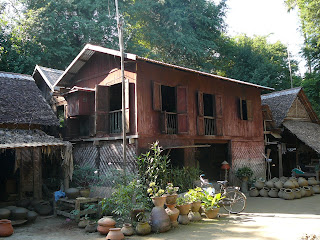
At 9:30am the next morning, our ship, the Pandaw 2, pulls into the river bank next to Yandabo a village famous for making clay pots. Here the population is 1,100, and apart from a few children playing truant, all the kids are in school. The adults are all busy making the pots, so we are greeted by just a few children and some of the older inhabitants who no longer work.

The school has been built with donations from previous passengers on this ship, helped by the shipping company. We visit the school, which is a comparatively modern brick building housing 5 classrooms packed with children.

They all learn English. The class of 5 year olds are working on the alphabet and we can see from the blackboard that they have got as far as “U for Umbrella” They are all excited to see us, and when we start taking photos they swarm round us wanting to see their pictures. At the end of our visit, the teachers gather them together and they sing two songs for us. We are told they are singing in English, but while we recognize the tunes, we can’t understand any of the words they are singing! But their huge excited smiles say it all.

The rest of the village is busy making the pots for which they are famous. We watch as one woman throws pots on a turntable operated by another woman pedaling a belt to operate it. Amazingly, this one woman can make 60 pots a day. We each have a turn at doing the pedaling, and it is so hard that none of us last more than a few minutes. This woman does it from dusk to dawn.


The pots are basic clay pots for cooking and for carrying and holding water. Some are plain and some are decorated.

When they have made enough, they arrange hundreds of pots in a field on a bed of straw, around a huge pile of firewood.


Then they cover everything with more straw and wood and set the whole thing alight. The pots are finally covered with ash and it operates as a kiln. The fire is kept going for three days and they use everything they can find as fuel, even down to the shells from peanuts that are a basic part of their diet. We arrive just as they are starting to make the fire. There are over three thousand pots waiting to be fired. It’s amazing that one small village with no tools or machinery can produce this much. The pots are large, unsophisticated but very attractive. They sell them for $2.50 each.
It is a bustling village, and seems quite prosperous.
The people are warm and welcoming, as they are in all these villages. I could spend hours watching and interacting with them but we have to move on. We have learned that the boat we are on also does a 12 day cruise that ventures into the north of Myanmar where there are no roads, and where you visit many more of these riverside villages. We are extremely interested in taking this cruise next year, and so are Derek and Helga. Much to our surprise, they want to make sure we are going before they book.

The school has been built with donations from previous passengers on this ship, helped by the shipping company. We visit the school, which is a comparatively modern brick building housing 5 classrooms packed with children.

They all learn English. The class of 5 year olds are working on the alphabet and we can see from the blackboard that they have got as far as “U for Umbrella” They are all excited to see us, and when we start taking photos they swarm round us wanting to see their pictures. At the end of our visit, the teachers gather them together and they sing two songs for us. We are told they are singing in English, but while we recognize the tunes, we can’t understand any of the words they are singing! But their huge excited smiles say it all.

The rest of the village is busy making the pots for which they are famous. We watch as one woman throws pots on a turntable operated by another woman pedaling a belt to operate it. Amazingly, this one woman can make 60 pots a day. We each have a turn at doing the pedaling, and it is so hard that none of us last more than a few minutes. This woman does it from dusk to dawn.


The pots are basic clay pots for cooking and for carrying and holding water. Some are plain and some are decorated.

When they have made enough, they arrange hundreds of pots in a field on a bed of straw, around a huge pile of firewood.


Then they cover everything with more straw and wood and set the whole thing alight. The pots are finally covered with ash and it operates as a kiln. The fire is kept going for three days and they use everything they can find as fuel, even down to the shells from peanuts that are a basic part of their diet. We arrive just as they are starting to make the fire. There are over three thousand pots waiting to be fired. It’s amazing that one small village with no tools or machinery can produce this much. The pots are large, unsophisticated but very attractive. They sell them for $2.50 each.
It is a bustling village, and seems quite prosperous.

The people are warm and welcoming, as they are in all these villages. I could spend hours watching and interacting with them but we have to move on. We have learned that the boat we are on also does a 12 day cruise that ventures into the north of Myanmar where there are no roads, and where you visit many more of these riverside villages. We are extremely interested in taking this cruise next year, and so are Derek and Helga. Much to our surprise, they want to make sure we are going before they book.
Friday, March 27, 2009
Inle Lake - A Day
We have heard that Inle lake is severely over fished, with catches getting smaller and smaller and as we set out to explore the lake it is immediately obvious why. The lake is covered with small boats each with a man fishing. They are in boats very similar to ours but a little shorter and without an engine.

Some drive fish towards nets by beating the water with long poles. Others stand on the small platform at the front, and wrap their leg around a long oar. Using a combined twisting of their body and circling motion of their leg they can propel the boat, and make girls hearts flutter on the dance floor. On the boat it leaves both hands free to fish, which they do with a fishing line, a net, or a huge cone shaped bamboo “beehive”.

These are the famous fishermen of Inle Lake and it is fascinating to watch them. Many of them are friendly and come along side our boat so that we can take pictures and exchange smiles of greeting.

We pay our first visit to a village where we meet the Pao tribe. The women wear all black with a colourful headdress, which actually looks like a small blanket folded neatly on top of their head, which must come in handy as it gets quite cold at night. You can tell which village they come from by the colour of this blanket. We go to see one of their markets, which is a desultory affair, with desperately poor looking women trying to sell tiny amounts of vegetables or spices.

Many of the women are smoking large fat cigars. We are not sure what is in the cigars, but they certainly seem happier than their immediate surroundings would warrant.

From here we go along the lake to the next village to see the Paduang tribe, famous for their long necked women.

The women wear gold coloured metal coils around their necks and calves. It gives the women very long necks, but apparently doesn’t actually stretch the neck, rather it pushes down the collar bone. They can take the coils off, but have to be extremely careful for three weeks until their collar bone recovers its original position. The origin of this is to protect from tigers, which always attack either the legs or the neck. There are only a handful of these women left, not because all the others have been killed by tigers, but because the majority of the tribe crossed the border to Thailand where they can make much more money from the tourist industry.

Some drive fish towards nets by beating the water with long poles. Others stand on the small platform at the front, and wrap their leg around a long oar. Using a combined twisting of their body and circling motion of their leg they can propel the boat, and make girls hearts flutter on the dance floor. On the boat it leaves both hands free to fish, which they do with a fishing line, a net, or a huge cone shaped bamboo “beehive”.

These are the famous fishermen of Inle Lake and it is fascinating to watch them. Many of them are friendly and come along side our boat so that we can take pictures and exchange smiles of greeting.

We pay our first visit to a village where we meet the Pao tribe. The women wear all black with a colourful headdress, which actually looks like a small blanket folded neatly on top of their head, which must come in handy as it gets quite cold at night. You can tell which village they come from by the colour of this blanket. We go to see one of their markets, which is a desultory affair, with desperately poor looking women trying to sell tiny amounts of vegetables or spices.

Many of the women are smoking large fat cigars. We are not sure what is in the cigars, but they certainly seem happier than their immediate surroundings would warrant.

From here we go along the lake to the next village to see the Paduang tribe, famous for their long necked women.

The women wear gold coloured metal coils around their necks and calves. It gives the women very long necks, but apparently doesn’t actually stretch the neck, rather it pushes down the collar bone. They can take the coils off, but have to be extremely careful for three weeks until their collar bone recovers its original position. The origin of this is to protect from tigers, which always attack either the legs or the neck. There are only a handful of these women left, not because all the others have been killed by tigers, but because the majority of the tribe crossed the border to Thailand where they can make much more money from the tourist industry.
Subscribe to:
Posts (Atom)