Showing posts with label village life. Show all posts

Friday, August 7, 2009

The Akhu Tribe

The next morning we are off again. This time we visit the village of Vansai , home to the Akhu tribe. Here the women all smoke pipes made from bamboo. They have a sort of turban on their head, and they carry their pipes, tobacco and matches in the folds of this turban. Their faces show the effect that tobacco smoke can have on the skin, as many of them have deeply etched wrinkles around the mouth and cheeks, but despite this we meet a woman of 92 with her great granddaughter slung on her back.


Inexplicably, women in all these tribes live to be much older than men. We have met several women in their 80’s as well as this lady in her 90’s, but few men seem to live beyond 60. It is hard to understand why this is, as the women work every bit as hard as the men, and in this village the women smoke constantly while the men do not.
In this village we also meet several men who are at home looking after the children while the women are in the jungle looking for firewood, or tending to the animals.


The Akhu is definitely more advanced than the Enn village but not as well organized as the Akha village. This is a Baptist village that has been guided by a pastor. Not to get involved in any sort of religious conflict, but it has to be said that the Catholic missionary did a much better job with his tribe.

Wednesday, August 5, 2009

Tea With The Akha Tribe

Again we distribute cookies and medicine. We meet two young girls with red paint all over their face. It turns out these girls had been fascinated by the red lips of a previous tourist, and she had kindly given the girls her lipstick. They had not had an occasion to wear it since, as there had been no visitors for months. But now we had arrived, they thought it appropriate to put it on. One of the girls had obviously forgotten that it was supposed to go on the lips, and had instead made red dots all over her face. The older girl had remembered where it was to go, but her skills of application were limited. She had a huge red gash from ear to ear. However both young women thought they looked beautiful, and as men have learned all over the world, it is always wise to offer no opposition to these feelings that women have.


Here we are invited to have tea in one of the houses. We feel we cannot turn this down, but we would much rather not drink out of any of the rather dirty looking glasses we are offered. However our guide says that they do wash their utensils in the river water. We follow the example of our guide who pours tea into his glass, swills it round and then tips it out, before pouring in more which he drinks. We are also offered deep fried peanuts straight from the pan, which are delicious, together with some bananas collected from the jungle. We are pleasantly surprised to find that we do not get sick the next day.
When we return to Kyaingtong in the late afternoon, we are both exhausted and promptly fall asleep.
This is not a town famous for its restaurants. There are a few local eating places, none of them catering to tourists. However that evening we find a Chinese restaurant that deep fries a whole fish caught that day in the river. It costs $3 and is delicious.

Monday, August 3, 2009

The Village of Nowohen

We walk down into a valley and up the other side to reach the village of Nowohen where the Akha tribe lives. They also wear black clothing, but this time the women have magnificent silver headdresses, rows of beaded necklaces and beaded belts and bags. The headdresses are made of real silver and have been handed down from mother to daughter. However many of the younger women have given up wearing them because they are so uncomfortable. This, combined with the fact that tourists will pay $500 for one headdress, means that within a few years it may no longer be possible to see this tribe in their original clothing.


This village is quite clearly far more prosperous than the last one, with the 26 houses laid out along two dirt streets, and small corrals with goats, chickens and pigs.


The homes are larger, and better constructed, although still just made of bamboo and matting. We are grateful to see that everyone looks clean, at least when compared to the last village. It turns out that the success of this village is almost entirely due to the fact that a missionary came here 14 years ago, and has taught the village basic principals of hygiene, village planning and husbandry. The entire village has converted to Catholicism. This originally caused some problems as prior to the Missionary’s arrival a tribesman was allowed two wives if he could afford them. In an example of true wisdom seldom seen in the church, the Missionary has told the people that this is fine, and that the arrangement can continue as long as the two wives were acquired before they became Christian.
In this village the wife has a separate bedroom from the husband, and if the husband desires sex, he must knock on her bedroom door first and be invited in. We might be centuries ahead of them in many ways, but we still could learn something from this tribe!

Friday, July 31, 2009

The Chief makes Us Welcome

All the men in the village of Banglu are busy building a new and comparatively grand home for the village chief. He is instantly recognizable as the chief, not because of anything he is wearing, but because of his bearing and demeanour. He is a most imposing man of about forty with great presence, and a huge smile.


He comes over and shakes our hand and thanks us for bringing the medicine. He invites us to see his home, which, besides having the usual dead rats hanging from the ceiling, also has a haunch of a pig hanging from the wall.


It still looks quite fresh. It will last the chiefs family many days and will go off after a few days, and smell terrible, but they will still eat it. The chief invites us to stay for lunch and promises us that we will get some meat, which is a great honour. However, there is no way either of us wants to eat anything here. We ask the guide if we can decline the offer without causing any offence, by saying we have already eaten. He explains this to the Chief, who fortunately understands.

We leave the village with the children waving goodbye and running after us. The people have been wonderfully warm and friendly, but our flesh is crawling and we want nothing more than hot water and soap. Unfortunately neither is available. We do come to a stream, where we stop and wash our hands. We have brought with us a picnic of fried rice which we sit and eat by the stream. We discover a group sharing their lunch nearby.


It is a beautiful spot, miles from the nearest road. There are huge brightly coloured butterflies all round us, and the only sounds come from the myriad of birds singing in the tropical trees, and three young children from a neighbouring village playing downstream.


Trekking is not my forte, but this is quite magical. We gather up the plastic bags, water bottles and containers that we carried our picnic up in, and give them to some passing tribes people who are thrilled. They can put them to good use in their homes. This is a true example of recycling.

Wednesday, July 29, 2009

Enn - Tribe

The people of Banglu have very little food, other than rice and a few vegetables. They catch whatever they can in the surrounding jungle, which is usually limited to the occasional rat. They skin the rats and leave them hanging in their homes to dry. Two or three rats will feed the entire village when added to a thin vegetable soup with rice and chilies. We visit a home where there is a collection of small animal skulls and skeletons hanging from the ceiling, the purpose of which is not made clear. A small fire is burning in the middle of the floor and a cooking pot with soup simmers on top.


The smell is not pleasant. A rattan basket holds a large amount of cooked rice which sits there for days, and the people just take what they need for each meal. Home sweet home to them, but about as far away from it as we can imagine.

On the advice of our guide we went to the local market before we left Kyaingtong and bought a huge amount of cookies for the children and an assortment of basic medicines and shampoo for the people. Word spreads quickly that tourists have arrived in the village, and the children are gathered around us within minutes. They are all filthy but full of smiles which win our hearts.


It is customary for these tribes people never to ask for anything, so although these children are hungry, have nothing, and know that we have treats that they would never normally get, they don’t beg. But when we produce the cookies they all get in a line to be given the treats, and thank us, as their turn comes for the cookies. If that doesn’t melt your heart, nothing will.

After that we all sit down in one of the huts, and the women who have health problems quietly line up to tell our guide what ails them. The guide dispenses the relevant medicine. Several of the women have diarrhea which is hardly surprising, but sadly we have not brought up any medicine for that. We are not too sure that the guide acting as a dispensing chemist is the answer to the tribe’s problems, but it is certainly better than nothing. They have not seen a tourist for three months and this is the only way they ever get medicine.

Monday, July 27, 2009

Banglu - Village

We are scheduled to do “light trekking” to visit some more tribes that are completely inaccessible by road. I know you will find the concept of me trekking as hard to believe as I did but I was persuaded by my desire to see these tribes and by the term “light”. Suffice it to say that I would not describe over 6 hours of walking up and down a small mountain as “light trekking”. However the day was riveting.

After a couple of hours walking straight up the mountain we come to the village of Banglu where the Enn tribe live. This is a collection of 24 huts each housing a large family. Each hut is made of bamboo and rush matting, which offers very little protection from the cold and it gets cold here as we are now quite high up. The homes are just a jumble of shacks in a dirt clearing in the jungle. The homes are built on stilts to protect them from the rainy season and to allow a place for their animal, if they are lucky enough to have one.


The tribes people wear black clothing decorated with brightly coloured ribbon and tiny beads of silver. But their clothing is ragged and dirty. There is no form of record keeping in this village, so no one knows how old they are. The Enn tribe is famous for its women who have black teeth and lips from their constant chewing of the betel nut. They never brush their teeth.


I had said earlier that the fishing tribe that we visited on Lake Inle were the poorest people we had ever met. Not any longer. This tribe is not only the poorest, but without doubt it is the dirtiest. They wear no shoes and their hands and feet are filthy, which presents a problem as the men all want to shake our hands. The details of their personal hygiene, or total lack of it, may offend the more delicate of you, so if this is the case you might want to skip to the next paragraph. There is no running water or plumbing, although they do have a series of horizontal bamboo pipes bringing water from the stream to the centre of the village.


They very rarely wash, but when they do, the women keep all their clothes on, presumably from a sense of modesty and because the water is so cold. The men never wash below their waist or above their thighs. That doesn’t bear thinking about. But it gets worse. There are many dogs in the village. When the people go to the toilet, they call the dogs over to lick the relevant body part of their body clean, and to clean up what they have deposited on the ground. But wait, I haven’t finished yet. Each family has acquired a few tin plates from which they eat. They never wash the plates, instead the dogs are called over after their meal to lick them clean. Try not to think about that, either.

Friday, July 24, 2009

The Paloung tribe of Northern Myanmar

Our guide for this adventure was also a little more rough and ready than we were used to. This was not Paris or A Boy named Sue. Actually we don’t know who it was, as his English was such that we never quite understood what his name was. He did manage to get across that we were his first tourists for two and a half months, but strangely enough he didn’t seem to be aware of why this was. He never mentioned politics or the generals and we felt that none of this had any relevance to his life. All he knew was that there were no tourists.

The first afternoon he took us to Wan Pao Village , home of the Paloung Tribe. This village is the only village we see that is accessible by car, albeit over an hours drive along a mud path. The village is a cluster of ramshackle huts randomly scattered over a muddy field. The tribe is known for two things. Firstly they are one of the few tribes that have huts made of mud. They make a bamboo frame and fill it with packed mud. This is great insulation against the cold, but unfortunately the ox and pigs find the mud walls appealing and tend to rub their sides on them, causing the walls to become thinner and thinner until they collapse.


The second point of interest is that all the women wear what looks like half a dozen small Hula Hoops around their waist made of silver and bamboo. They are completely inflexible and seem to be more of an annoyance than anything else. This particular village is also famous for its blacksmith, a man of 82 who is working when we get there, making shock absorbers for the local cars.


Apparently shock absorbers and springs for the old Toyotas are impossible to get hold off, and this man has learned how to make them despite the fact that there is not one car in the village, and he has never learned to drive.

Wednesday, July 1, 2009

Thoughts on Burma as we Cruise down the Irrawaddy

The rest of the day is spent gently cruising down the river. While we are sitting idly on the sun deck watching the world go by, albeit it very slowly, we are left to ponder some of the things we have seen and learned so far in Burma:

1. A huge majority of the people are dressed in clothes which are falling apart, but are always comparatively clean.

2. Children have to wear a school uniform of a green longyi with a white shirt for both girls and boys. They also have to buy all their books, paper and pencils. Consequently many parents can’t afford to send their children to school.

3. Women do not wear wedding rings. Instead they wear their long shiny black hair pinned up if they are married, or hanging down their back if they are single. Presumably it is fairly easy to let your hair fall down accidentally.

4. Many towns away from the river have no water supply. Water is piped to a central collection point. The local villagers then have to collect it and take it to their villages. They use barrels placed on a cart and pulled by oxen to do this.

5. The landscape that is not farmed is full of bushes and trees that are all young and small. Trees taller than about 20 feet are a rarity, with the exception of palm trees. This is a direct result of the deforestation, especially of the teak trees. It is one of the worst countries in the world for deforestation.

6. At around 5 or 6 each evening the sky becomes full of smoke, sometimes becoming so thick that it makes you choke. This is because everyone burns their rubbish each evening.

7. Burma makes one of the best beers in the world – Myanmar Beer. It is really inexpensive, and on this ship it is free just like the soft drinks.

8. Burma also has a wine industry with a few vineyards. It is a young industry with a lot to learn. But when 90% of the population is Buddhists, and good Buddhists don’t drink, one has to wonder why they are bothering.

Monday, June 29, 2009

Yandabo on The Road to Mandalay

At 9:30am the next morning, our ship, the Pandaw 2, pulls into the river bank next to Yandabo a village famous for making clay pots. Here the population is 1,100, and apart from a few children playing truant, all the kids are in school. The adults are all busy making the pots, so we are greeted by just a few children and some of the older inhabitants who no longer work.


The school has been built with donations from previous passengers on this ship, helped by the shipping company. We visit the school, which is a comparatively modern brick building housing 5 classrooms packed with children.


They all learn English. The class of 5 year olds are working on the alphabet and we can see from the blackboard that they have got as far as “U for Umbrella” They are all excited to see us, and when we start taking photos they swarm round us wanting to see their pictures. At the end of our visit, the teachers gather them together and they sing two songs for us. We are told they are singing in English, but while we recognize the tunes, we can’t understand any of the words they are singing! But their huge excited smiles say it all.


The rest of the village is busy making the pots for which they are famous. We watch as one woman throws pots on a turntable operated by another woman pedaling a belt to operate it. Amazingly, this one woman can make 60 pots a day. We each have a turn at doing the pedaling, and it is so hard that none of us last more than a few minutes. This woman does it from dusk to dawn.


The pots are basic clay pots for cooking and for carrying and holding water. Some are plain and some are decorated.


When they have made enough, they arrange hundreds of pots in a field on a bed of straw, around a huge pile of firewood.


Then they cover everything with more straw and wood and set the whole thing alight. The pots are finally covered with ash and it operates as a kiln. The fire is kept going for three days and they use everything they can find as fuel, even down to the shells from peanuts that are a basic part of their diet. We arrive just as they are starting to make the fire. There are over three thousand pots waiting to be fired. It’s amazing that one small village with no tools or machinery can produce this much. The pots are large, unsophisticated but very attractive. They sell them for $2.50 each.

It is a bustling village, and seems quite prosperous.
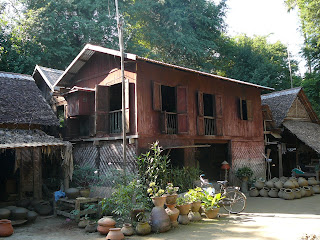

The people are warm and welcoming, as they are in all these villages. I could spend hours watching and interacting with them but we have to move on. We have learned that the boat we are on also does a 12 day cruise that ventures into the north of Myanmar where there are no roads, and where you visit many more of these riverside villages. We are extremely interested in taking this cruise next year, and so are Derek and Helga. Much to our surprise, they want to make sure we are going before they book.

Wednesday, June 24, 2009

Ohn Ne Choung

The village is a 45 minute walk to the nearest road, and so the most convenient transport they have is boats, and any outside life they see is brought to them by whatever boats stop at their river bank. Consequently the arrival of the Pandaw 2 is cause for great excitement and the entire village has turned out to welcome us. Actually it is almost entirely children who are waiting on the river bank, waving and smiling as we arrive.


The village has a population of 1800, and 1000 of them are children. This is the result of a village with very little electricity and only one television.
There must be over a hundred children greeting us and they are delightful. They get an enormous amount of pleasure from having their photo taken and then seeing it reproduced on the screen on the back of the camera.


Most of them are under 10 and obviously have not seen themselves very often, and some don’t recognize themselves. The other kids tell them that it is them they are looking at and there is a huge amount of giggling. There is one boy of about 10 who has a tattered New York Yankees cap, which he is wearing sideways.


Street fashion has reached a village in Burma , that has no streets
We are told not to offer the kids any money. Instead, we are asked to give any candy or money that we have to the school teacher who will distribute it later.


This way they do not learn to beg and so we have a delightful time without any of the begging that we are besieged with in the larger towns. They follow us everywhere and some even hold our hands. We do give the school teacher some money, but it disappears into his pocket and we have a sneaking suspicion that it will stay there and not reach the kids.