We are flying to Kyaingtong to see the different tribes of Northern Mynamar that remain unaffected and virtually untouched by the outside world. We arrive in a very different Myanmar . The airport at Kyaingtong is little more than a couple of huts next to an airstrip. But security is the tightest we have seen. We are deep in the heart of the Golden Triangle and close to the Chinese border. This was the notorious heroin capital of the world, but the Junta claims to have completely wiped out all the poppy plantations over the last few years. Tourists have only been allowed back in over the last four years. Consequently there are none of the luxuries we have been enjoying. The hotel we are staying in is known to be the best in town, but would not qualify for one star. We were well aware of this when planning our trip and were rather anxious about what we would find. It was maybe even more basic than we expected, but we were happy to find that it was comparatively clean, and the staff very welcoming and friendly. However all the laundry was done by hand with no hot water, so the sheets and towels were grey, which was a little disturbing. We were on the third floor (no elevator of course). At the end of our corridor there was a door marked “emergency exit”. For a moment we were reassured, but then we discovered it was just a door opening on to a three storey drop into the middle of the neighbour’s pigsty. No stairs, no balcony. Nothing.
We are in the high country and the temperatures have plummeted. But there is no heating in the hotel and some of the windows have fixed open slatted glass. It is colder in the hotel than outside and Gordon, who feels the cold, is miserable. He sleeps with all his clothes on underneath a huge pile of blankets.
Showing posts with label Mandalay. Show all posts
Showing posts with label Mandalay. Show all posts
Wednesday, July 22, 2009

Monday, July 20, 2009
Mandalay Airport
Mandalay has an international airport that can rival any of the major Asian airports. Glass and steel everywhere, restaurants, cafes, escalators and jetways. The only difference between Mandalay and other well known International airports is passengers! Mandalay has none. There are maybe a dozen other passengers in the entire airport. One café is open, all the restaurants are closed. But even more strange is the fact that none of the escalators is working. Nor are the luggage conveyor belts. Nor are the jetways. We have to walk down some stairs and across the tarmac to our plane. The reason, of course, is that this is one of the days when there is no electricity in Mandalay. The airport is vast and very modern. It puts Yangon airport to shame. And yet Yangon is the city that has all the international flights. It is almost impossible to find an international flight that goes to Mandalay, there are only internal flights. This impressive airport was built two years ago, but no one knows why. It is built in the middle of nowhere, a good hours drive from town. The old airport was much more convenient but the Junta announced it could no longer be used.
We have an hour to wait for our plane, and go to the only café that is open. It goes by the name of Swan Pizza, and their logo is remarkably similar, if not identical to, Pizza Hut. However they do not sell pizza. Even more incongruous is that they have large black plastic napkin dispensers on each table which have “ Las Vegas ” emblazoned in gold on all sides. Our sandwich is served on white plates that match the coffee cups. All of them have “J.C. Penny. Basic White” printed on the underside.
We have an hour to wait for our plane, and go to the only café that is open. It goes by the name of Swan Pizza, and their logo is remarkably similar, if not identical to, Pizza Hut. However they do not sell pizza. Even more incongruous is that they have large black plastic napkin dispensers on each table which have “ Las Vegas ” emblazoned in gold on all sides. Our sandwich is served on white plates that match the coffee cups. All of them have “J.C. Penny. Basic White” printed on the underside.
Friday, July 10, 2009
Life In Mandalay
Mandalay is a much more attractive city than Yangon. Many of the streets are lined with trees, and bustle with people who seem happier and a little more prosperous than in Yangon . Large portions of the city have good middle class houses. Downtown is more like a downtown as we know it, with many streets full of shops, and a few selling named brands that are definitely high end. There is even a small shopping mall and a few neon signs, although the latter seems rather superfluous because of the lack of power to turn them on.
There are many motorbikes and thousands of bicycles that appear to take no notice of the rules of the road.

Road junctions and cross roads often have a policeman in the middle directing traffic, but no one pays them any attention. Cross roads are quite terrifying, and we sit white knuckled in our car, clinging to the back of the seat in front of us. I try closing my eyes, but it is impossible to keep them closed with all the noise around us.
This is the first place we have seen taxis, but they are not geared to the tourists. They are Mazda pick up trucks built in the 1940’s. They are amazingly small, looking like children’s toy cars. The passengers sit in the back of the pick up truck. You could perhaps squeeze two Americans in the back, but they would be very unhappy. But up to 10 Burmese somehow manage to ride this way.

We are pleased to see that there are many more monks here than anywhere we have been so far. The Mayor of Mandalay refused the Generals orders to kill monks and so Mandalay escaped much of the crackdown. But once the uprising was crushed the Mayor was fired from his job. There are also many nuns, who wear pink robes, and, like the monks go out in the morning to collect food from the people. However nuns can only go out twice a week and can only accept rice and vegetables.
We visit several craft houses, all of them working without lighting. We watch as women stoop over their embroidery doing the most intricate work in semi darkness. Three men noisily beat gold into gold leaf. They will be deaf by the end of their worklife.

Like the rest of the country, electricity is limited. Here they receive power for three days, and then just for 6 to 12 hours on the other four days. Water too is problematical. Each household has to pay $200 for the connection, a large amount of money to most families. On top of this they pay a monthly fee based on usage, but during the dry season there will often be no water available. Few have hot water, and sometimes the mornings are too cold for them to take a shower. If they live in houses and apartments that are more than two stories high, very often the water will not pump up to the higher floors.
There are many motorbikes and thousands of bicycles that appear to take no notice of the rules of the road.

Road junctions and cross roads often have a policeman in the middle directing traffic, but no one pays them any attention. Cross roads are quite terrifying, and we sit white knuckled in our car, clinging to the back of the seat in front of us. I try closing my eyes, but it is impossible to keep them closed with all the noise around us.
This is the first place we have seen taxis, but they are not geared to the tourists. They are Mazda pick up trucks built in the 1940’s. They are amazingly small, looking like children’s toy cars. The passengers sit in the back of the pick up truck. You could perhaps squeeze two Americans in the back, but they would be very unhappy. But up to 10 Burmese somehow manage to ride this way.

We are pleased to see that there are many more monks here than anywhere we have been so far. The Mayor of Mandalay refused the Generals orders to kill monks and so Mandalay escaped much of the crackdown. But once the uprising was crushed the Mayor was fired from his job. There are also many nuns, who wear pink robes, and, like the monks go out in the morning to collect food from the people. However nuns can only go out twice a week and can only accept rice and vegetables.
We visit several craft houses, all of them working without lighting. We watch as women stoop over their embroidery doing the most intricate work in semi darkness. Three men noisily beat gold into gold leaf. They will be deaf by the end of their worklife.

Like the rest of the country, electricity is limited. Here they receive power for three days, and then just for 6 to 12 hours on the other four days. Water too is problematical. Each household has to pay $200 for the connection, a large amount of money to most families. On top of this they pay a monthly fee based on usage, but during the dry season there will often be no water available. Few have hot water, and sometimes the mornings are too cold for them to take a shower. If they live in houses and apartments that are more than two stories high, very often the water will not pump up to the higher floors.
Wednesday, July 8, 2009
Mandalay
Our first stop is the old Royal Palace built in the 1860’s. It is a huge square compound, surrounded on all four sides by a wall and a moat The wall is two kilometres long on each of the four sides.

The entire place was bombed in the war, and virtually destroyed. The government, recognizing a tourist attraction when they see one, decided to rebuild it in the 1990’s. However, where there were once huge wooden columns there are now huge cement columns, and where there was gold leaf covering everything there is now gold paint. It all looks so tacky, and very few people go there. To make matters worse the huge grounds that were so beautiful, are now full of unsightly cheap housing used solely to house army soldiers. Min, our guide, is making her opening political statement by taking us here first.

However a block or so away is one of the original buildings. It is in this building that the King died, and his son wanted to preserve it as a special and separate monument, so moved it away from the palace, thus unwittingly insuring its survival during the bombings. It is one of the most beautiful buildings I have ever seen, built entirely of teak and covered in intricate carvings. Both inside and out were originally covered in gold, but very little remains on the outside because of the weather. But the inside still gleams, the many tall golden pillars supporting the roof look like a shining forest, It is an amazing sight, that dazzles the eye.


From here we go to lunch in a local restaurant where we have to listen to a CD of Christmas Carols sung in English by a Burmese singer who obviously learned parrot fashion from listening to the original, and has no idea what he is saying. We recognize the song “I saw Mommy Kissing Santa Claus”, but instead of singing “If Daddy had only seen” He sang” If Veddy Veddy on the scene”, and “He thought that I was tucked up in my bedroom fast asleep” became “he thawed a ice water up in my bedroom vast and leap".

The entire place was bombed in the war, and virtually destroyed. The government, recognizing a tourist attraction when they see one, decided to rebuild it in the 1990’s. However, where there were once huge wooden columns there are now huge cement columns, and where there was gold leaf covering everything there is now gold paint. It all looks so tacky, and very few people go there. To make matters worse the huge grounds that were so beautiful, are now full of unsightly cheap housing used solely to house army soldiers. Min, our guide, is making her opening political statement by taking us here first.

However a block or so away is one of the original buildings. It is in this building that the King died, and his son wanted to preserve it as a special and separate monument, so moved it away from the palace, thus unwittingly insuring its survival during the bombings. It is one of the most beautiful buildings I have ever seen, built entirely of teak and covered in intricate carvings. Both inside and out were originally covered in gold, but very little remains on the outside because of the weather. But the inside still gleams, the many tall golden pillars supporting the roof look like a shining forest, It is an amazing sight, that dazzles the eye.


From here we go to lunch in a local restaurant where we have to listen to a CD of Christmas Carols sung in English by a Burmese singer who obviously learned parrot fashion from listening to the original, and has no idea what he is saying. We recognize the song “I saw Mommy Kissing Santa Claus”, but instead of singing “If Daddy had only seen” He sang” If Veddy Veddy on the scene”, and “He thought that I was tucked up in my bedroom fast asleep” became “he thawed a ice water up in my bedroom vast and leap".
Monday, July 6, 2009
Mandalay - The First Sights
A magical morning as we sail into Mandalay. We sail under two iron bridges with hills on either side, full of golden stuppas that glisten in the early morning sun.

Small fishing boats with one solid bright coloured sail, emerge slowly out of the mists and smoke that rise off the land and drift across the wide river. Ships carrying huge piles of rice chug along the river and are laden to the point where it seems that they would sink if you loaded one more sack on board. The ships are as old and dilapidated as the buses from the 1940’s, and their crews aren’t much better. They are all in dirty white T shirts and ragged longyis, and they wave as we go by.

It is exactly as we imagined it as kids in school, reading Rudyard Kipling and learning about the glory days of the British Empire.
Once ashore we are met by our new guide, Min, a woman of about 40 suffering from a severe case of flu. It seems that half the country is in the grips of flu.. A Boy named Sue had it, but not badly, his driver had it, the two other passengers on the ship had it, two of the crew had it, and it is obvious that many people we see have it. But no one has seemed as sick as Min, who we are sure will not make it through the day. She is dressed for winter, with a rather strange hand knitted pink wool hat pulled down to her eyebrows, and a matching scarf wrapped twice round her neck and mouth. She has a huge padded coat which she holds tightly around her body, boots and a pair of gloves. The only part of her body exposed to the elements is her eyes. Where she found this clothing is a mystery, Mandalay is always hot and we never saw a shop selling anything like these clothes. She had to blow her nose constantly, which unfortunately she did directly into her hand, and then wiped her hand with a piece of toilet paper. This was not appealing.
Both she and her husband are tour guides, and have two children. Because of the lack of tourists they were in dire straits and she has to work, no matter how sick she feels. She is only able to talk in a whisper because of her sore throat, and has to stop often to cough. We are reluctant to deprive her of the little income we are bringing her, so we control our impulse to tell her to go home.

Small fishing boats with one solid bright coloured sail, emerge slowly out of the mists and smoke that rise off the land and drift across the wide river. Ships carrying huge piles of rice chug along the river and are laden to the point where it seems that they would sink if you loaded one more sack on board. The ships are as old and dilapidated as the buses from the 1940’s, and their crews aren’t much better. They are all in dirty white T shirts and ragged longyis, and they wave as we go by.

It is exactly as we imagined it as kids in school, reading Rudyard Kipling and learning about the glory days of the British Empire.
Once ashore we are met by our new guide, Min, a woman of about 40 suffering from a severe case of flu. It seems that half the country is in the grips of flu.. A Boy named Sue had it, but not badly, his driver had it, the two other passengers on the ship had it, two of the crew had it, and it is obvious that many people we see have it. But no one has seemed as sick as Min, who we are sure will not make it through the day. She is dressed for winter, with a rather strange hand knitted pink wool hat pulled down to her eyebrows, and a matching scarf wrapped twice round her neck and mouth. She has a huge padded coat which she holds tightly around her body, boots and a pair of gloves. The only part of her body exposed to the elements is her eyes. Where she found this clothing is a mystery, Mandalay is always hot and we never saw a shop selling anything like these clothes. She had to blow her nose constantly, which unfortunately she did directly into her hand, and then wiped her hand with a piece of toilet paper. This was not appealing.
Both she and her husband are tour guides, and have two children. Because of the lack of tourists they were in dire straits and she has to work, no matter how sick she feels. She is only able to talk in a whisper because of her sore throat, and has to stop often to cough. We are reluctant to deprive her of the little income we are bringing her, so we control our impulse to tell her to go home.
Monday, June 29, 2009
Yandabo on The Road to Mandalay
At 9:30am the next morning, our ship, the Pandaw 2, pulls into the river bank next to Yandabo a village famous for making clay pots. Here the population is 1,100, and apart from a few children playing truant, all the kids are in school. The adults are all busy making the pots, so we are greeted by just a few children and some of the older inhabitants who no longer work.

The school has been built with donations from previous passengers on this ship, helped by the shipping company. We visit the school, which is a comparatively modern brick building housing 5 classrooms packed with children.

They all learn English. The class of 5 year olds are working on the alphabet and we can see from the blackboard that they have got as far as “U for Umbrella” They are all excited to see us, and when we start taking photos they swarm round us wanting to see their pictures. At the end of our visit, the teachers gather them together and they sing two songs for us. We are told they are singing in English, but while we recognize the tunes, we can’t understand any of the words they are singing! But their huge excited smiles say it all.

The rest of the village is busy making the pots for which they are famous. We watch as one woman throws pots on a turntable operated by another woman pedaling a belt to operate it. Amazingly, this one woman can make 60 pots a day. We each have a turn at doing the pedaling, and it is so hard that none of us last more than a few minutes. This woman does it from dusk to dawn.


The pots are basic clay pots for cooking and for carrying and holding water. Some are plain and some are decorated.

When they have made enough, they arrange hundreds of pots in a field on a bed of straw, around a huge pile of firewood.


Then they cover everything with more straw and wood and set the whole thing alight. The pots are finally covered with ash and it operates as a kiln. The fire is kept going for three days and they use everything they can find as fuel, even down to the shells from peanuts that are a basic part of their diet. We arrive just as they are starting to make the fire. There are over three thousand pots waiting to be fired. It’s amazing that one small village with no tools or machinery can produce this much. The pots are large, unsophisticated but very attractive. They sell them for $2.50 each.
It is a bustling village, and seems quite prosperous.
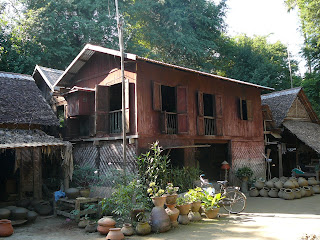
The people are warm and welcoming, as they are in all these villages. I could spend hours watching and interacting with them but we have to move on. We have learned that the boat we are on also does a 12 day cruise that ventures into the north of Myanmar where there are no roads, and where you visit many more of these riverside villages. We are extremely interested in taking this cruise next year, and so are Derek and Helga. Much to our surprise, they want to make sure we are going before they book.

The school has been built with donations from previous passengers on this ship, helped by the shipping company. We visit the school, which is a comparatively modern brick building housing 5 classrooms packed with children.

They all learn English. The class of 5 year olds are working on the alphabet and we can see from the blackboard that they have got as far as “U for Umbrella” They are all excited to see us, and when we start taking photos they swarm round us wanting to see their pictures. At the end of our visit, the teachers gather them together and they sing two songs for us. We are told they are singing in English, but while we recognize the tunes, we can’t understand any of the words they are singing! But their huge excited smiles say it all.

The rest of the village is busy making the pots for which they are famous. We watch as one woman throws pots on a turntable operated by another woman pedaling a belt to operate it. Amazingly, this one woman can make 60 pots a day. We each have a turn at doing the pedaling, and it is so hard that none of us last more than a few minutes. This woman does it from dusk to dawn.


The pots are basic clay pots for cooking and for carrying and holding water. Some are plain and some are decorated.

When they have made enough, they arrange hundreds of pots in a field on a bed of straw, around a huge pile of firewood.


Then they cover everything with more straw and wood and set the whole thing alight. The pots are finally covered with ash and it operates as a kiln. The fire is kept going for three days and they use everything they can find as fuel, even down to the shells from peanuts that are a basic part of their diet. We arrive just as they are starting to make the fire. There are over three thousand pots waiting to be fired. It’s amazing that one small village with no tools or machinery can produce this much. The pots are large, unsophisticated but very attractive. They sell them for $2.50 each.
It is a bustling village, and seems quite prosperous.

The people are warm and welcoming, as they are in all these villages. I could spend hours watching and interacting with them but we have to move on. We have learned that the boat we are on also does a 12 day cruise that ventures into the north of Myanmar where there are no roads, and where you visit many more of these riverside villages. We are extremely interested in taking this cruise next year, and so are Derek and Helga. Much to our surprise, they want to make sure we are going before they book.
Monday, June 22, 2009
The Road To Mandalay
Our ship, The Pandaw 2, takes the phrase “at a leisurely pace” to new extremes. At times it is hard to tell that we are moving and every other boat on the river overtakes us, even the little one man fishing boats. At some point we expect to see a row boat go past. The four of us sit on the sundeck in the reclining chairs, a drink in hand, surrounded with staff, and watch the life on the river bank as it slowly passes by. We have never felt so decadent and we agree that we are taking indolence to a new level.
At 4pm, we stop at a small village called Ohn Ne Choung, and are free to wander round for an hour. There is no dock, and the ship merely pulls into the river bank and throws out a gang plank.

We cross it and climb the steep sandy bank to find the village. The houses are the usual two room affairs made of bamboo and rattan. Each has a large fenced area around it with either a pig, or an ox tethered in the yard, or the well to do have both, plus chickens. It’s a bit like having your car and dinner sitting in the garden. There are narrow lanes between the houses often lined with trees making it very picturesque. There are some wider roads to allow the ox and cart to travel through it. The ground is very fine dirt, almost sand like, and so everywhere is dusty. There are a few power lines and no running water or sewer pipes. All the water is taken from the river, which is filthy. There is a constant stream of people going down to the river to fetch water in two pails hanging from a bamboo pole strung across their neck.


At 4pm, we stop at a small village called Ohn Ne Choung, and are free to wander round for an hour. There is no dock, and the ship merely pulls into the river bank and throws out a gang plank.

We cross it and climb the steep sandy bank to find the village. The houses are the usual two room affairs made of bamboo and rattan. Each has a large fenced area around it with either a pig, or an ox tethered in the yard, or the well to do have both, plus chickens. It’s a bit like having your car and dinner sitting in the garden. There are narrow lanes between the houses often lined with trees making it very picturesque. There are some wider roads to allow the ox and cart to travel through it. The ground is very fine dirt, almost sand like, and so everywhere is dusty. There are a few power lines and no running water or sewer pipes. All the water is taken from the river, which is filthy. There is a constant stream of people going down to the river to fetch water in two pails hanging from a bamboo pole strung across their neck.


Friday, June 19, 2009
Irrawaddy - Our Ship
We board a ship for a two night cruise down the Irrawaddy to Mandalay , the same journey that Rudyard Kipling made so famous in his poem, the Road to Mandalay . It is a wonderful feeling to be traveling in his footsteps and the ship we are on recreates the atmosphere perfectly.

We are traveling on the Pandaw 2, which is a copy of the original Pandaw , designed in 1948 expressly for travel on the Irrawaddy . It has a draft of only three and a half feet, and what is mind boggling about the original is that it was built in Scotland and actually sailed from there to Burma with this shallow draft. The ships have been redesigned for today’s traveler and are a wonderful mix of modern day comfort with colonial design. Al l the cabins and fixtures are made of teak, the furniture is rattan and there is an extensive sundeck with teak reclining chairs. Our cabin opens onto the deck and there are two rattan chairs outside our door for our private use.

There are only 24 cabins and the ship boasts a staff of 26. However on our cruise there are just 4 passengers including us, so we get over 6 staff each!

Navigating the Irrawaddy has always been extremely difficult, because of its perilous waterways. It is a shallow and extremely wide river, full of sandbanks. There are neither locks nor weirs to control the water level, as there are on other great rivers of the world. Nor are there charts, as the sands shift with such rapidity that they would be out of date before the ink was dry. Instead they rely on a pilot ship that goes in front and marks a safe channel with bamboo poles. But even this method is not perfect, as we discover on our first night. At one point we are sandwiched between two fast shifting sandbanks that cut off our passage. We have to turn round and find another route past them. Several times during our trip we have two crew members standing either side of the bow of the ship measuring the depth of the river with long bamboo poles. They continually call out the depth to the captain and at one point we were down to less than 5ft.

We are traveling on the Pandaw 2, which is a copy of the original Pandaw , designed in 1948 expressly for travel on the Irrawaddy . It has a draft of only three and a half feet, and what is mind boggling about the original is that it was built in Scotland and actually sailed from there to Burma with this shallow draft. The ships have been redesigned for today’s traveler and are a wonderful mix of modern day comfort with colonial design. Al l the cabins and fixtures are made of teak, the furniture is rattan and there is an extensive sundeck with teak reclining chairs. Our cabin opens onto the deck and there are two rattan chairs outside our door for our private use.

There are only 24 cabins and the ship boasts a staff of 26. However on our cruise there are just 4 passengers including us, so we get over 6 staff each!

Navigating the Irrawaddy has always been extremely difficult, because of its perilous waterways. It is a shallow and extremely wide river, full of sandbanks. There are neither locks nor weirs to control the water level, as there are on other great rivers of the world. Nor are there charts, as the sands shift with such rapidity that they would be out of date before the ink was dry. Instead they rely on a pilot ship that goes in front and marks a safe channel with bamboo poles. But even this method is not perfect, as we discover on our first night. At one point we are sandwiched between two fast shifting sandbanks that cut off our passage. We have to turn round and find another route past them. Several times during our trip we have two crew members standing either side of the bow of the ship measuring the depth of the river with long bamboo poles. They continually call out the depth to the captain and at one point we were down to less than 5ft.
Subscribe to:
Posts (Atom)